
Criminal Court Cases in Mecklenburg County
Mecklenburg County criminal court cases belong to one state court system. Superior Court hears felony trials. District Court hears misdemeanors and the early stages of felony matters, including first appearances and other preliminary work. Both are part of Judicial District 26, and the Clerk of Superior Court maintains their files. Charlotte, Huntersville, and Cornelius do not keep separate municipal criminal dockets. A city ordinance charge or a state offense from one of those towns still moves into the Mecklenburg County District or Superior Court record.
The case file is the best source for what prosecutors filed and what the court did. It can show that a booking charge was changed, dismissed, split into several counts, or resolved by a plea or trial. The arrest entry remains a different document. Readers tracing events from custody through judgment can use the Mecklenburg County arrest search for the booking side, then return to the clerk's file for the filed charges and outcome.
Mecklenburg Criminal Actions in eCourts
The North Carolina eCourts Portal is the main remote route for Mecklenburg County criminal case information. Smart Search accepts a party name or Enterprise Justice case number. Advanced filters can limit results to Mecklenburg, Criminal Actions, a case type, status, or filing-date range. Those limits matter in a large urban county where a common name may return many unrelated results.
The official Portal training resources explain field use, wildcard syntax, hearings, judgments, and payment functions. The image below shows that official training source. It helps a reader distinguish the search controls from the case tabs that appear after a result opens.
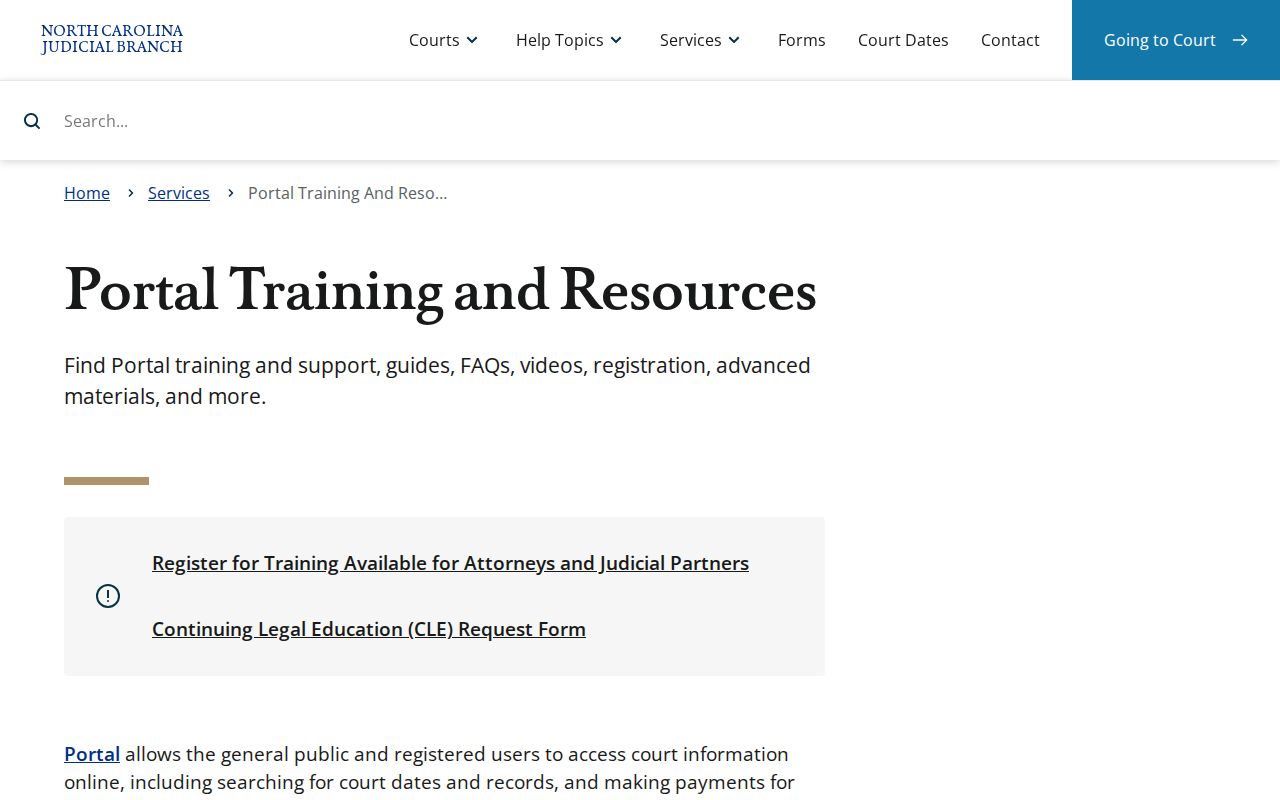
Use the training page when a broad name query produces too many Mecklenburg County court cases or a partial entry returns none.
Mecklenburg County Case Record Searches
Start online for speed, but keep the clerk as the source for inspection, copies, and certified results. A sound Mecklenburg County criminal case search follows the record from its index entry to the disposition rather than stopping at the first charge line.
- Open Smart Search and enter a party name or full Enterprise Justice case number.
- Expand Advanced Filtering Options. Set Location to Mecklenburg and Case Category to Criminal Actions.
- Add date of birth criteria, case status, case type, or a filing-date range when the name alone is not distinct.
- Open the result. Read the summary, events, hearings, dispositions, and financial information together for each count.
- Use the clerk's public terminal, paper file, copy service, or certified search when the online view lacks a needed document.
| Field | Type | Required | Use |
|---|---|---|---|
| Search phrase | Text | Yes | Party name or case number; wildcards are allowed |
| Location | Multi-select | No | Select Mecklenburg to remove other counties |
| Party criteria | Filters | No | Name and date of birth criteria |
| Case category | Multi-select | No | Select Criminal Actions |
| Case type and status | Dropdowns | No | Narrow the kind and current state of the matter |
| Filing date range | Date fields | No | Limit results by filing period |
Reset broad filters before trying a new spelling. Too many limits can hide the right Mecklenburg County criminal case as easily as too few can bury it.
Mecklenburg Court Search Wildcard Rules
A false “no record” result often comes from the query, not the Mecklenburg County case index. For a partial case number, the Judicial Branch directs users to enter at least four characters and an asterisk. A partial party search needs at least three last-name characters plus an asterisk and at least one first-name character plus an asterisk. Aliases and dates of birth can help separate people with similar names.
Enterprise Justice numbers have four parts: a two-digit year, a letter case type, a six-digit sequence, and a three-digit county identifier. Search the known number before relying on a name match. Then compare the court location, filing date, and public party details. A name alone does not prove that a Mecklenburg County criminal case belongs to the person being researched.
Note: Portal is a public case-information tool; the Judicial Branch directs formal Mecklenburg County criminal-record checks to the clerk.
What a Criminal Case File Contains
An opened Mecklenburg County court file can hold far more than a charge label. Read the docket as a sequence. The header identifies the matter, events show its movement, hearings show scheduled court activity, and dispositions record the result of each charge. Documents are not always available as remote images, so the online docket may point to a filing that must be inspected at the clerk's office.
| Case number and court | Enterprise Justice number, Mecklenburg location, filed date, case type, and status |
|---|---|
| Parties | State, defendant, and attorneys, with protected identifiers withheld |
| Charges | Description, count, offense date, statute or code, class, and charge-level outcome |
| Events | Initiation, service, first appearance, counsel, settings, motions, plea or trial, and later activity |
| Hearings | Event type, date, time, courtroom, judicial officer, and status when populated |
| Disposition and judgment | Dismissal, conviction, acquittal, sentence, and other count-specific results |
| Financial entries | Costs, fines, restitution, balances, and payments where applicable |
Match each disposition to its count. A single Mecklenburg County case can contain several charges with different results and one later judgment entry.
Mecklenburg Criminal Cases Before Odyssey
October 9, 2023 is a key line in Mecklenburg County's digital court history. The county converted to Enterprise Justice and Odyssey then. An older criminal file that does not appear in Portal may still exist in the clerk's paper or legacy records. The proper next step is not to assume that no case exists.
For a missing pre-conversion matter, contact the Mecklenburg criminal division and give the record type, party name, and file number if known. The public counter and self-service terminals at 832 East Fourth Street, Charlotte, are open from 9 a.m. to 5 p.m. on weekdays. The Mecklenburg County court location page provides the current local route and service notices. North Carolina completed the same Enterprise Justice system in all 100 counties in October 2025, which improves cross-county consistency but does not make every older document remotely viewable.
Criminal Case Stages in Mecklenburg County
A Mecklenburg County criminal case may begin after an arrest or citation, but the booking label does not lock in the final court charge. A judicial official addresses the initial appearance and release conditions. The prosecutor evaluates the matter. Felony prosecution may proceed through indictment or another authorized charging route, while misdemeanors remain in District Court. Motions, continuances, and plea talks become docket events as the case moves.
Case flow: Charges Filed › Arraignment › Pretrial › Plea or Trial › Disposition › Sentencing
Resolution may be a dismissal, plea, trial verdict, or a different result for each count. Judgment records the sentence. Appeals or post-conviction activity can add later entries, so an old summary should be checked for newer events before anyone treats it as final.
Certified Mecklenburg Criminal Case Searches
Portal access is free, yet the North Carolina Judicial Branch says a background check should be obtained through the clerk rather than treated as a Portal query. The Mecklenburg Clerk of Superior Court offers a certified county criminal-record search for $25. This is a county court index product, not a statewide fingerprint record and not an FBI identity history.
The clerk also supervises public terminals, paper-file inspection, and requests for copies. The official court-record access instructions describe those channels. The image below comes from that source and reinforces why online access and courthouse access are two parts of the same Mecklenburg County case lookup.
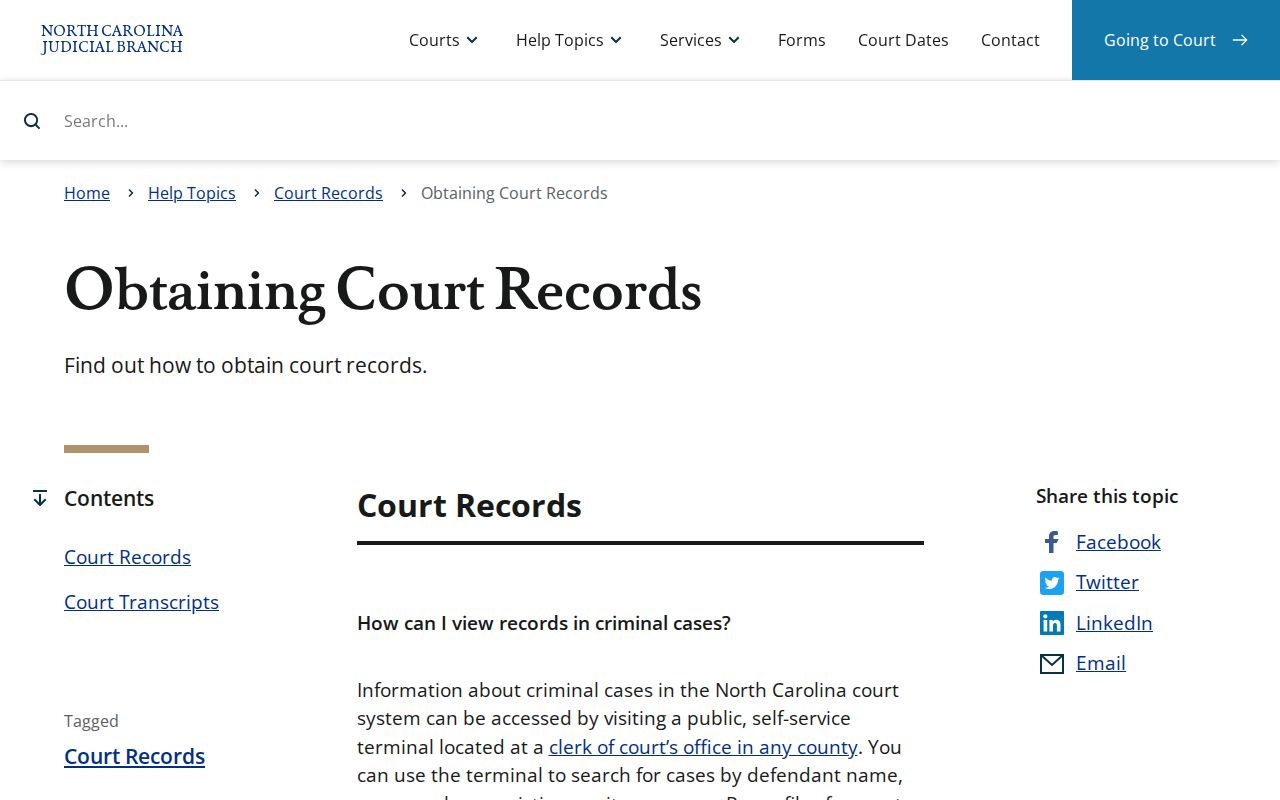
Ordinary Judicial Branch public-record copies are listed at 25 cents per page, while court-file and certification charges can differ under the current costs chart.
Reading Mecklenburg Criminal Case Outcomes
“Disposed” describes the case's status, but it does not mean every count ended the same way. One count may be dismissed while another produces a conviction. A disposition is the recorded result of a charge. A judgment is the formal court decision that can include sentence terms, costs, a fine, restitution, or probation.
- Dismissal
- The prosecutor or court ends a charge without a conviction.
- Acquittal
- A not-guilty result after guilt was not proven.
- Conviction
- Guilt established by plea or adjudication.
- Judgment
- The court's formal decision, including sentence when one is imposed.
- Restitution
- Payment ordered for a qualifying loss, separate from a fine.
Read events, disposition, judgment, and financial tabs together. A police report may preserve the first allegation, and an MCSO booking may preserve the intake charge. The Mecklenburg County court case record is the place to see what was actually filed and how the court resolved it.
Access Rules for Case Records
North Carolina law supports public access while leaving the clerk in charge of the court file. N.C.G.S. §7A-109 provides access to court records and copies under clerk supervision. Chapter 132 governs public records more broadly, but it is not a command to disclose every field in a Mecklenburg County criminal case.
Full Social Security numbers, protected victim or minor data, juvenile material, and properly expunged records are not exposed simply because a request is made. The online view can also be narrower than the paper file. If a document is listed but unavailable to download, ask the clerk whether it may be inspected or copied. If a case cannot be found, check spellings, aliases, dates, the file number, and the legacy route before drawing a conclusion.