
Charlotte Criminal History Checks
Begin with the record type, not a broad request for everything. A CMPD crime report captures the police account. An MCSO booking entry documents intake after a custodial arrest. North Carolina eCourts shows the filed case and its outcome. The SBI Right to Review is the route for a person's own fingerprint-supported statewide record. Each source can be correct even when its wording or date differs.
- Use CMPD's report routes when the event was reported to Charlotte police. Gather the incident number, date, and location if possible.
- Request the city report online, at the records counter, or through the City public-record portal when no direct lookup fits.
- Check MCSO Resident or Arrest Inquiry for a custodial booking and call the sheriff when online data does not answer the question.
- Search eCourts under Mecklenburg and Criminal Actions for filed charges, hearings, dispositions, and judgments.
- For a fingerprint-supported review of one's own North Carolina record, follow the official SBI Right to Review process.
A Charlotte criminal record search should end with the record that answers the question. The police narrative cannot prove a conviction, and a booking charge may change before court.
Keep the identifiers found at each step. They make the next Charlotte request faster and reduce the risk of joining records from two people with similar names.
Three Charlotte Criminal Record Buildings
Charlotte's Uptown justice campus puts three key counters close together, yet each belongs to a different government. CMPD Police Records is at 601 East Trade Street. MCSO's Arrest Processing Center is at 801 East Fourth Street. The Mecklenburg County Courthouse is at 832 East Fourth Street. Sending the request to the wrong one creates delay because no office owns the whole record chain.
| Charlotte Stop | Records Held | Public Channel |
|---|---|---|
| CMPD Records | Crime, incident, crash, calls-for-service, and related police records | Online report routes, records counter, division office, or City request |
| MCSO APC | Booking, custody, bond, release, and warrant verification information | Resident/Arrest Inquiry, Public Information, phone, or in person |
| Mecklenburg Clerk | Filed criminal cases, hearings, dispositions, judgments, and certified county searches | eCourts, public terminals, paper file, email fallback, or clerk counter |
Charlotte police records stay with the city even when an arrest later moves into county booking and state court systems.
Records at the Charlotte Police Department
The Charlotte-Mecklenburg Police Department Records unit provides free crime or incident reports online, at its first-floor lobby, or at a CMPD division office. The Records counter at 601 East Trade Street is open from 8 a.m. to 5 p.m. on weekdays, and CMPD's main telephone is 704-336-7600. The department does not issue a local arrest-history product. It directs that type of request to the Mecklenburg Clerk.
Crash reports follow a separate cost path. A copy is free at the CMPD counter or a division office, while the online accident-reporting system linked by CMPD charges $9. Crime reports remain free. For either route, bring enough detail to identify the event, such as report or incident number, date, location, and involved party. A public-record request should add the record type, date range, delivery preference, and requester contact information.
CMPD Police Records
601 E. Trade St.
Charlotte, NC 28202
704-336-7600
Weekdays, 8 a.m.-5 p.m.
Free incident and crash reports are available at the counter; the linked online crash report costs $9.
Charlotte CrimeMapper Record Tools
CMPD's media and data hub routes residents to CrimeMapper, public records, open data, and MyCMPD resources. CrimeMapper can help identify an incident number or review reported activity in an area. The City request portal is the better route for a broader Charlotte record that does not fit a standard crime-report lookup.
The official CMPD media-resources page is the source for the Charlotte image below.
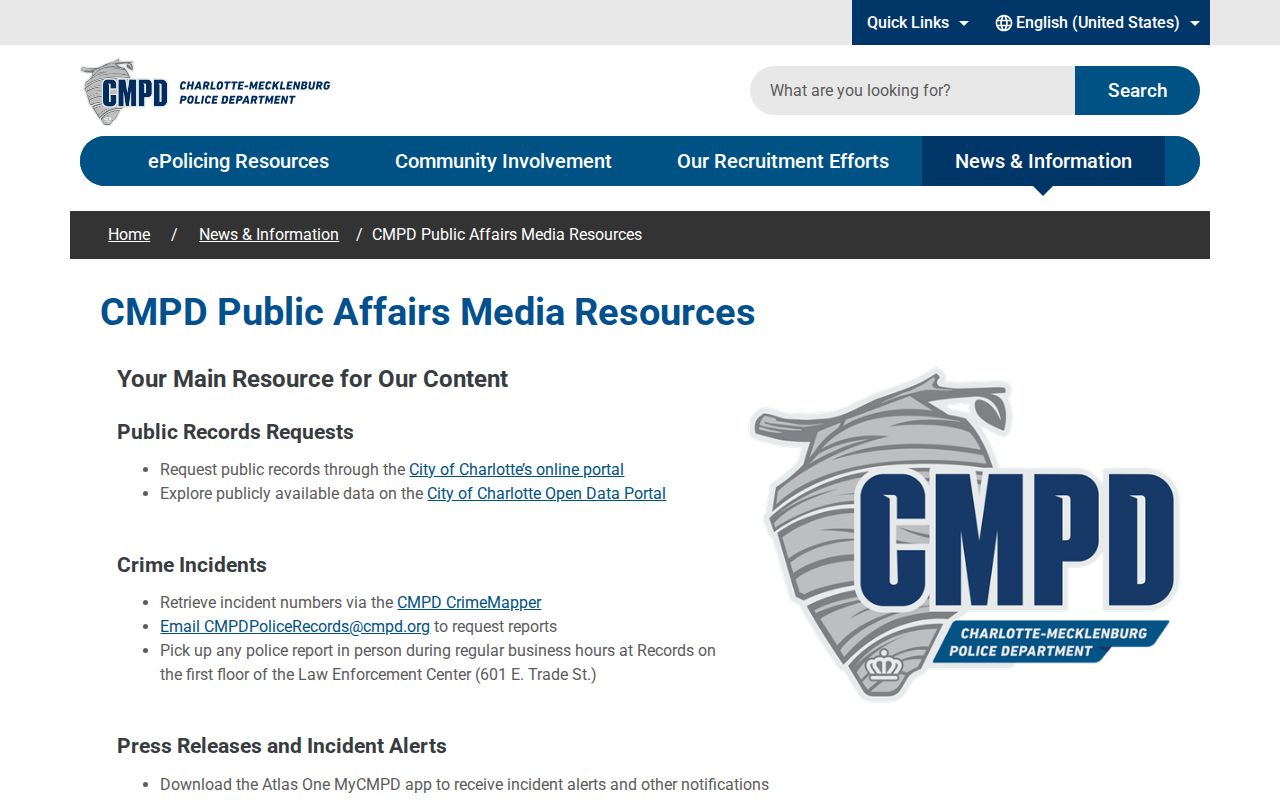
These tools point to different records, so the right link depends on whether the need is an incident identifier, a released report, public data, or an alert.
MyCMPD runs through Atlas One and provides incident alerts and notifications. It is not an arrest database, a court docket, or a substitute for MCSO inquiry. The distinction matters when an alert prompts a later Charlotte records search.
Booking and Arrest Records in Charlotte
CMPD makes arrests, but custodial booking is centralized at the Mecklenburg County Sheriff's Office Arrest Processing Center. APC operates continuously at 801 East Fourth Street. It records demographics, electronic fingerprints, a digital photograph, charges, property, bond, release conditions, and transfers. Onsite technicians work with SBI and FBI responses to verify identity.
The MCSO Resident and Arrest Inquiry gateway displays arrest or resident information for three years after arrest or release. If the person may still be held, MCSO provides general detention information at 704-336-8100. VINE at 1-800-247-9658 covers committed residents and custody notifications, but it omits people who bonded out before commitment.
When online arrest or warrant information is unavailable, contact MCSO Public Information at 980-314-5170 or APC at 980-314-5100. A Charlotte incident report remains with CMPD. The later court disposition belongs to the clerk. The Mecklenburg County arrest search addresses the full countywide chain.
Note: An arrest documents custody on an accusation; it does not prove guilt or establish the court's final charge.
Charlotte Arrest Records Move to MCSO
A single CMPD arrest can create four related records. The officer first creates the incident or arrest report. APC then creates the booking entry and fingerprint transaction. A magistrate and the clerk create judicial process and a case if charges proceed. SBI can later receive fingerprint-supported arrest data and a reported disposition.
Charlotte arrest flow: CMPD incident › MCSO booking › Mecklenburg court case › SBI criminal-history cycle.
The stages do not update at the same moment. A charge can be amended or dismissed after booking. A dismissal in eCourts may coexist with the MCSO entry until the three-year display period ends or the sheriff receives a signed expunction order. Compare dates, identifiers, and disposition rather than assuming one screen cancels another.
The Charlotte Municipal Court File
Charlotte has no separate municipal criminal court. City offenses and state-law charges are handled within North Carolina District and Superior Courts at the Mecklenburg County Courthouse. District Court hears misdemeanors and preliminary felony matters. Superior Court is the felony trial court. Both divisions are served by the Clerk of Superior Court.
Use North Carolina eCourts Portal for public case research. Select Mecklenburg as the location and Criminal Actions as the category, then narrow by status, case type, filing date, name, or date of birth when available. Public terminals and paper files at the clerk remain the fallback. A certified Mecklenburg county criminal-record search costs $25.
| Court Name | North Carolina District Court and Superior Court, Judicial District 26, rather than a Charlotte municipal criminal court. |
|---|---|
| Case Types Heard | District Court handles misdemeanors and early felony stages; Superior Court hears felony trials. |
| Case Lookup Channel | eCourts Portal, clerk public terminal, paper-file inspection, or legacy-record email and counter route. |
| What the Docket Shows | Case number, charges, events, hearings, parties, dispositions, judgment, and financial entries when public. |
| Copies & Fees | A certified county criminal-record search is $25; copy and certification charges should be confirmed with the clerk. |
Older Charlotte Court Record Searches
Mecklenburg converted to Odyssey on October 9, 2023. A Charlotte criminal file from before that date may not appear in Portal even when it remains available from the clerk. The absence of an online result is not proof that the case never existed, was dismissed, or was expunged.
For an older missing file, contact the Mecklenburg criminal division or visit the Clerk at 832 East Fourth Street. Provide the record type, party name, and file number if known. Public terminals can search by defendant, case number, or victim and witness name. Paper inspection is still useful when a docket lists an event but does not expose the underlying document.
The Mecklenburg County court case lookup explains the court stages, Portal fields, and document fallback in more depth.
How Charlotte Records Reach the County
CMPD keeps its own police narratives because it is a City of Charlotte department. MCSO is a county agency and owns the booking or detention record created at APC. The criminal court is part of the state Judicial Branch, even though the file is indexed in Mecklenburg. SBI is the state repository for fingerprint-supported criminal history.
Record flow: Charlotte-Mecklenburg Police Department › Mecklenburg County Sheriff and Courts › North Carolina State Bureau of Investigation.
That line is not a promise that every detail copies forward. The police report can include allegations and property data not found on the docket. A booking entry captures the charge at intake. The case file shows what prosecutors filed and how each count ended. A person's own SBI Right to Review organizes fingerprint-linked arrest cycles and reported outcomes. Use the source closest to the fact being checked.
What Charlotte Crime Records Measure
CMPD's official 2025 report recorded 5,852 violent offenses, down from 7,436 in 2024. It listed 96 homicides versus 110, 1,050 robberies versus 1,389, and 35,112 property offenses versus 37,451. Vehicle thefts fell from 7,442 to 5,960. These totals describe reported offenses under FBI Uniform Crime Reporting summary standards.
The figures are not conviction counts and do not describe how many unique people were arrested. One incident can have several offenses, and a reported offense may not lead to a custodial arrest or guilty judgment. Use the CMPD Crime Statistics Report for the agency's current comparisons, then use case sources for an individual outcome.
Charlotte Body Camera Record Requests
Body-worn camera footage does not follow the same release path as a basic CMPD incident report. North Carolina uses a special, court-controlled disclosure process. CMPD publishes a Video Disclosure Request form, and the requester must supply enough detail to identify the recording. That can include the incident, date, location, recording type, and involved person, along with verification documents when required.
The form may be dropped at a CMPD division office. A general Chapter 132 request does not make the video automatically available because a separate statute governs disclosure. This is a common Charlotte records trap: the related basic incident facts may be public while the recording requires a different review and order path.
Keep the video request narrow. Identify the recording type, event, date, time range, and Charlotte location, then attach the verification material the form calls for. A CMPD report number can connect the request to the right incident. The disclosure decision concerns access to the recording itself and does not change the incident report, MCSO booking entry, or court case that may exist elsewhere.
Charlotte Record Access Rules
North Carolina law gives the public access to many city and court records, but it does not erase specific restrictions. Ask the creating office. CMPD handles its reports, MCSO handles sheriff records, and the clerk supervises court files. Social Security numbers, financial-account data, protected victim or minor identities, juvenile material, and restricted investigative content may be withheld or redacted.
Key Statutes:
North Carolina Public Records Law, Chapter 132 defines public records and inspection rights while preserving statutory exceptions.
N.C.G.S. §132-1.4 makes specified basic law-enforcement information public but treats investigative records differently.
N.C.G.S. §7A-109 provides access to court records and copies under the clerk's supervision.
A narrowly framed request is easier to route. Include the agency, record type, date range, location, and known incident or case number. The City and county request portals are routes to the proper custodian, not a shared database.