
Mecklenburg County Criminal History Checks
No one database contains every Mecklenburg County criminal record. Begin with the event you need to confirm. The North Carolina eCourts Portal shows filed court cases. The Clerk of Superior Court supplies public terminals, paper files, certified copies, and a county search. Mecklenburg County Sheriff channels cover bookings, custody, and warrant verification. CMPD and town police departments hold the incident narratives they created. A full self-review of fingerprint-linked North Carolina history goes through the SBI.
Use a full name, spelling variants, date of birth when the official form permits it, and any known case, incident, or booking number. A common name alone is weak proof. Match the agency, dates, charges, and disposition before treating results as one person's record.
- Search eCourts Smart Search by party name or case number, set Location to Mecklenburg, and select Criminal Actions.
- Compare likely matches by birth details, filing date, case type, and case number.
- Check MCSO custody or arrest channels for booking facts, then ask the arresting police agency for its report.
- Read the court events and each charge disposition, since the initial arrest charge may change.
- Visit or contact the clerk for a missing older file, certified copy, or official Mecklenburg County search.
Five Mecklenburg Criminal Record Systems
Mecklenburg County's Uptown justice campus makes the offices look close, yet their files remain separate. The state Clerk of Superior Court keeps criminal cases. MCSO creates booking and detention records. CMPD is a City of Charlotte agency, so it answers for CMPD reports rather than all county police work. The SBI stores fingerprint-linked state criminal history, while the North Carolina Department of Adult Correction tracks prison and community-supervision status. A request sent to the wrong layer can produce a valid response that still misses the record sought.
The county's official public-records router illustrates those separate paths.
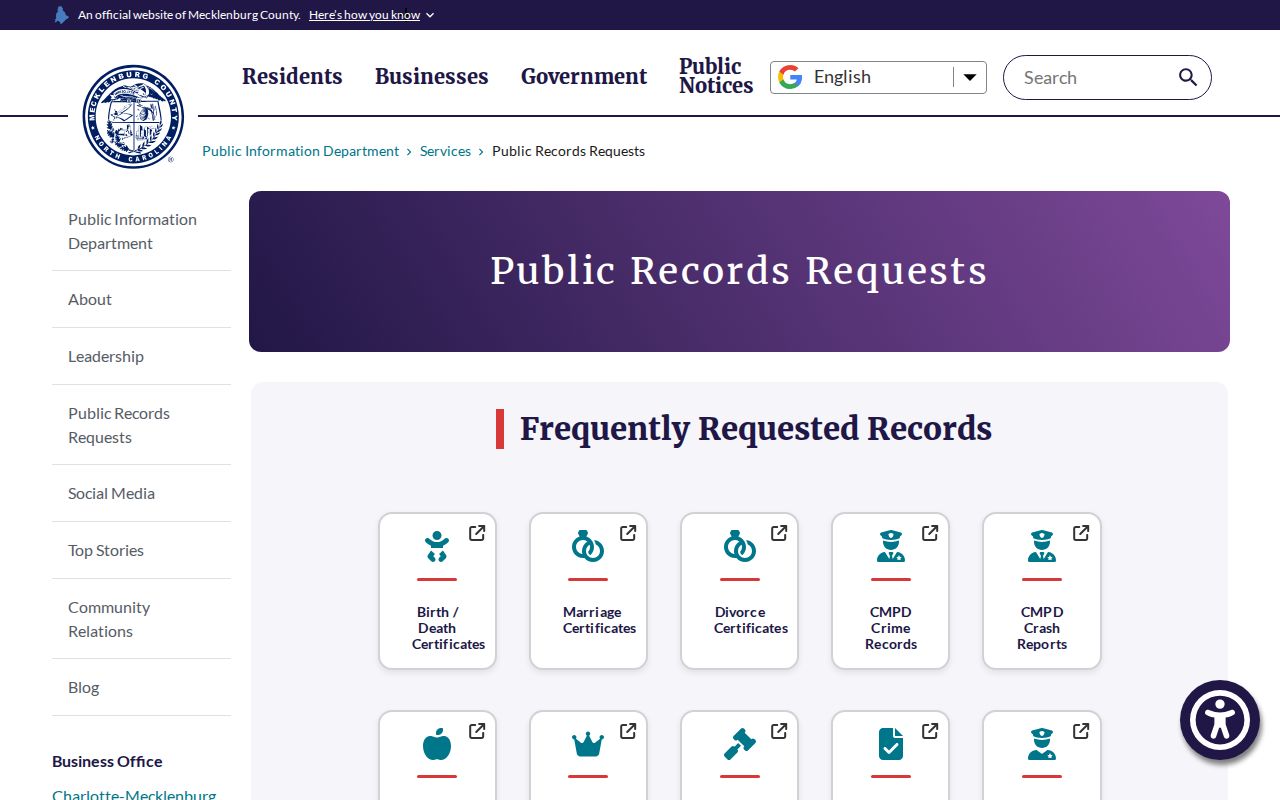
Its category links help route court, warrant, inmate, arrest, police report, and county-administration requests to the office that owns the source file.
Clerk of Superior Court
832 E. Fourth St., Charlotte, NC 28202
9 a.m.-5 p.m. weekdays
Cases, terminal searches, copies, and certified county checks.
MCSO Arrest Processing
801 E. Fourth St., Charlotte, NC 28202
980-314-5100
Bookings, detention intake, and warrant verification.
CMPD Records
601 E. Trade St., Charlotte, NC 28202
704-336-7600
Open 8 a.m.-5 p.m. weekdays for CMPD incident and crash reports.
Official Background Checks in North Carolina
The North Carolina State Bureau of Investigation does not offer a general public name-search portal. A person who wants to inspect their own fingerprint-linked North Carolina record uses the SBI Right to Review process. The request needs a legible fingerprint card and a $14 certified check or money order. Each extra copy costs another $14. MCSO lists fingerprinting assistance at 704-336-3665, but callers should confirm its current site, identification rules, hours, and appointment process.
For a certified Mecklenburg County court-index search, the Clerk charges $25. Free eCourts research is useful for public case information, but the Judicial Branch directs official county criminal record checks to the clerk. A person reviewing their own national identity history can order an FBI Identity History Summary for $18 and submit fingerprints. These products have different coverage, so price does not tell which one fits the need.
| Official route | Coverage | Fee | Main limit |
|---|---|---|---|
| SBI Right to Review | Subject's fingerprint-linked NC history | $14 | Personal review by form, fingerprints, and mail |
| Mecklenburg Clerk search | County court index | $25 | Not a national rap sheet |
| eCourts Portal | Public statewide cases | Free | Not the official background-check substitute |
| FBI Identity History Summary | Subject's FBI identity file | $18 | Fingerprints required |
Mecklenburg Records on Fourth Street
The Mecklenburg County Courthouse page is the official starting point for an in-person court record check.
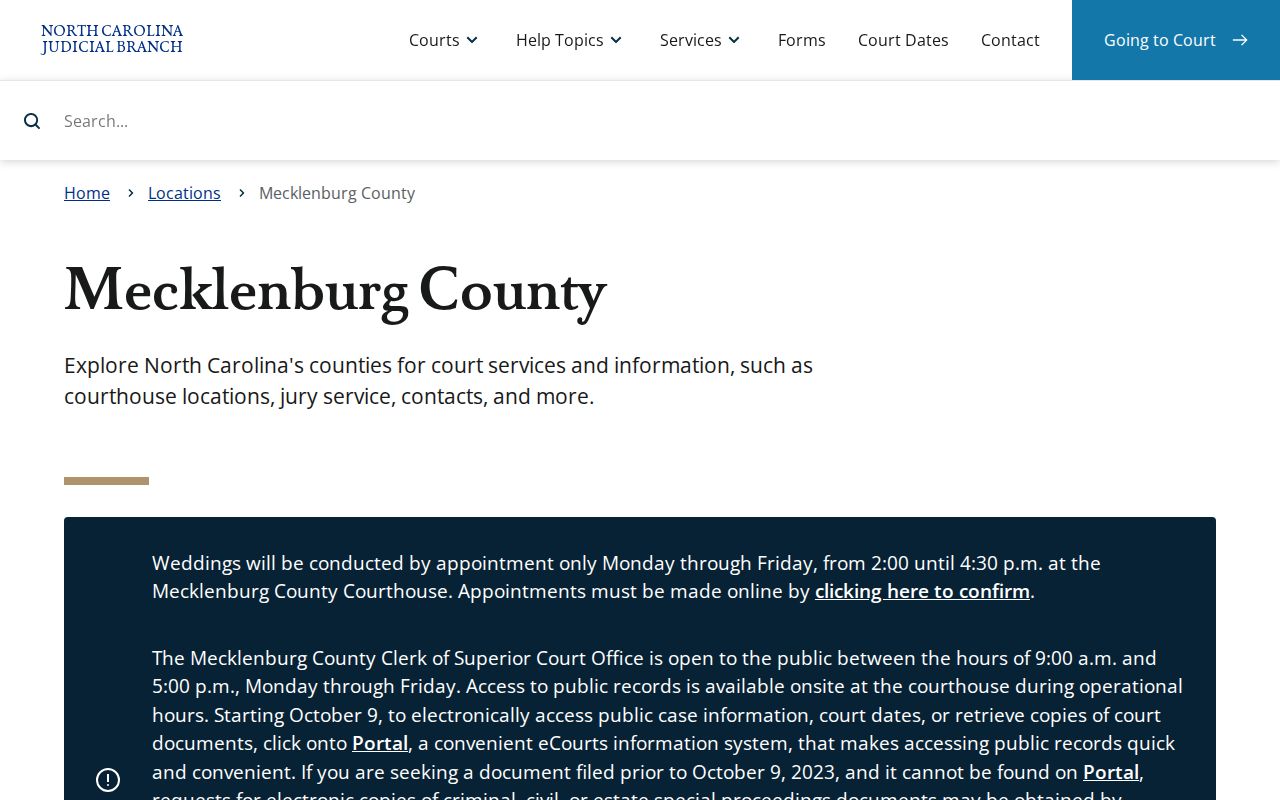
The courthouse at 832 East Fourth Street holds the clerk's counter and terminals. MCSO's Arrest Processing Center and Detention Center Central sit at 801 East Fourth Street, while CMPD Records is at 601 East Trade Street. That short walk crosses state, county, and city record systems.
Courthouse visitors enter on McDowell Street and pass security screening. The official location page lists the Fourth Street and Government Center decks at $1 per half hour and $12 per day, with no ordinary visitor validation. Phones and laptops may enter, but photography, filming, and audio recording need advance written permission. Those rules matter when inspecting a paper criminal record. Ask the clerk about copies rather than assuming a phone photo is allowed.
Older criminal files need special care. Mecklenburg County moved to Odyssey on October 9, 2023. A file created before that date may not appear in Portal even though the clerk still holds it. Email the criminal division with the record type, party name, and file number if known, or inspect the paper file at the courthouse.
Kinds of Criminal Records
A Mecklenburg County record search works best when the document is named precisely. A police incident report contains the first agency account and allegations. APC then creates a booking file if a person enters custody. A magistrate or other judicial official creates process, while the clerk opens a criminal court file when charges proceed. Later, the SBI may pair fingerprint-supported arrest data with a reported disposition. Each record marks a different point in the case.
- Incident reports: CMPD, a town police department, MCSO, or another arresting agency records the reported event and its initial investigation.
- Booking records: APC records intake identity, fingerprints, photograph, charge, bond, custody, and release data.
- Court cases: the clerk holds charges, hearings, pleadings, outcomes, judgments, and financial entries.
- Warrant records: judicial process may appear through the related case, MCSO verification, or older hard-copy repositories.
- Correctional records: NCDAC tracks state prison and community supervision, while MCSO tracks the local jail.
The North Carolina Sex Offender and Public Protection Registry is another distinct system. It reflects a registration duty, not a full criminal case file. For a focused registry search, use the Mecklenburg County sex offender lookup and verify safety-critical facts with the sheriff.
Mecklenburg Arrest Records Converge at APC
Mecklenburg County's Arrest Processing Center is the countywide intake point for custodial arrests made by CMPD, town police, state troopers, and other law-enforcement agencies. It operates around the clock. Staff record demographics, electronic fingerprints, a digital photograph, property, charges, bond terms, holds, transfers, and release data in the Offender Management System. Onsite fingerprint technicians help send identity data into state and federal channels, while court updates can change the charge or bond entries after intake.
Record flow: Arresting agency › MCSO booking › magistrate and clerk case › SBI disposition reporting.
This flow explains a common Mecklenburg County mismatch. The arresting police report may retain the first alleged offense. The booking system shows what APC received. Prosecutors may amend or decline charges, and the court records the outcome. A dismissed case can coexist for a time with an MCSO booking display. MCSO says arrest and resident information remains online for three years from arrest or release unless it receives a signed expunction order.
Resident Inquiry separates resident, arrest, and civil inquiry routes and offers a printer-friendly view. Use the Mecklenburg County arrest search for the complete official fallback chain, including MCSO phone, VINE, court, arresting-agency, and public-record request options.
Mecklenburg County Criminal Records: What They Contain
A Mecklenburg County criminal record is not a single fixed form. Portal case data can show case number, filing date, court, parties, charge details, events, hearings, disposition, judgment, and financial entries. An APC booking entry centers on identity and custody. An SBI response centers on fingerprint-linked arrest cycles and reported outcomes. Read the field in light of the office that created it.
| Name & Identifiers | Names, aliases, birth details, booking or case identifiers, and fingerprint identifiers where the product permits them. |
|---|---|
| Arrest / Booking Data | Arrest and intake dates, arresting agency, booking number, charge at intake, bond, custody, transfer, and release. |
| Charges & Statutes | Offense description, count, alleged offense date, code citation, and felony or misdemeanor class. |
| Disposition | Charge-level result such as dismissal, conviction, acquittal, or another recorded outcome. |
| Sentence | Judgment, costs, fine, restitution, custody, probation, or other terms when public and entered. |
| Custody / Supervision Status | Local jail status through MCSO or state prison and community status through NCDAC. |
- Disposition
- The recorded result for a charge or case.
- Indictment
- A grand-jury charging instrument used in Superior Court prosecution.
- Bond
- A financial or nonfinancial condition meant to secure a court appearance.
- Expunction
- North Carolina's statutory process for removing eligible records from public systems.
Mecklenburg Criminal Records Split at 2023
October 9, 2023 is the key digital line for Mecklenburg County court research. That is when the county converted to Odyssey and eCourts. Portal now provides statewide Smart Search, yet migration does not mean each old paper filing became a remotely viewable document. Search by party or Enterprise Justice case number, choose Mecklenburg and Criminal Actions, then filter by status, type, or filing dates. If the result is absent, the clerk's legacy email and counter remain necessary.
Enterprise Justice case numbers contain a two-digit year, a letter case type, a six-digit sequence, and a three-digit county identifier. Wildcards help when only part is known. Judicial Branch instructions call for at least four case-number characters before *. A party wildcard needs at least three last-name characters plus * and one first-name character plus *.
| Portal field | Use in a Mecklenburg search | Required |
|---|---|---|
| Search phrase | Party name or case number; wildcard supported | Yes |
| Location | Select Mecklenburg | Optional |
| Case Category | Select Criminal Actions | Optional |
| Case Status | Narrow active, disposed, and other statuses | Optional |
| Filing Date Range | Limit results by from and to dates | Optional |
North Carolina Public Access Laws
North Carolina law opens many Mecklenburg County government and court records, but it does not turn them into one central database. Ask the creating office. The clerk supervises court files, police agencies answer for their reports, MCSO handles sheriff and jail records, and the SBI provides a person's own fingerprint record. Juvenile files, expunged matters, protected victim details, Social Security and account numbers, and some investigative material stay restricted or redacted.
Key statutes:
N.C.G.S. Chapter 132 defines public records and inspection rights subject to specific exceptions.
N.C.G.S. §7A-109 places court records and copies under clerk supervision and supports public access.
N.C.G.S. §132-1.4 treats basic law-enforcement information differently from protected investigative content.
N.C.G.S. §15A-146 governs expunction of qualifying dismissed and not-guilty charges.
N.C.G.S. Article 27A controls registry publication and prohibits harassment or unlawful use.
A broad county request is free to submit, but actual copy or special-service costs can depend on scope. Ordinary NCAOC public-record copies are listed at $0.25 per page, while statutory court-file and certification charges may differ. A narrow request should identify the agency, date range, incident or case number, location, desired format, and delivery method.
Verify Mecklenburg Warrants Without Paying
MCSO says online arrest and warrant inquiry data became unavailable during the July 2022 eWarrants transition. Since the Odyssey conversion, some process may appear with the related court case, but public visibility still depends on case and warrant status. The safe Mecklenburg County fallback is to search the case, call APC at 980-314-5100, submit a focused MCSO records request, and ask the clerk about court-issued process. Sealed warrants, indictments, and juvenile process are not public.
The sheriff warns that MCSO never calls to demand money for a warrant, missed jury matter, or monitoring program. End such a call. Then dial APC or the issuing court through its independently published number. A caller cannot sell a valid recall, and only the proper court can set or clear judicial process.
The Warrant Repository also explains why a web search can be incomplete. Alongside electronic functions, APC retains hard-copy warrants issued before 2013 plus civil orders for arrest, restraining orders, grand-jury indictments, and governor's warrants. Older Mecklenburg criminal process may require staff verification rather than a portal result.
Restricted, Sealed & Expunged Records
North Carolina uses the term expunction. Mecklenburg County petitions are filed with the Clerk of Superior Court at 832 East Fourth Street when the charge or conviction arose there. The Judicial Branch form table links each ground to an AOC form. Common routes include dismissed charges under §15A-146 and eligible nonviolent convictions under §15A-145.5. The usual filing fee is $175, though dismissal and not-guilty petitions generally have no fee unless a diversion or deferred-prosecution completion led to dismissal. An indigency application may be available.
The North Carolina Judicial Branch expunction resource shows the official form and filing framework.
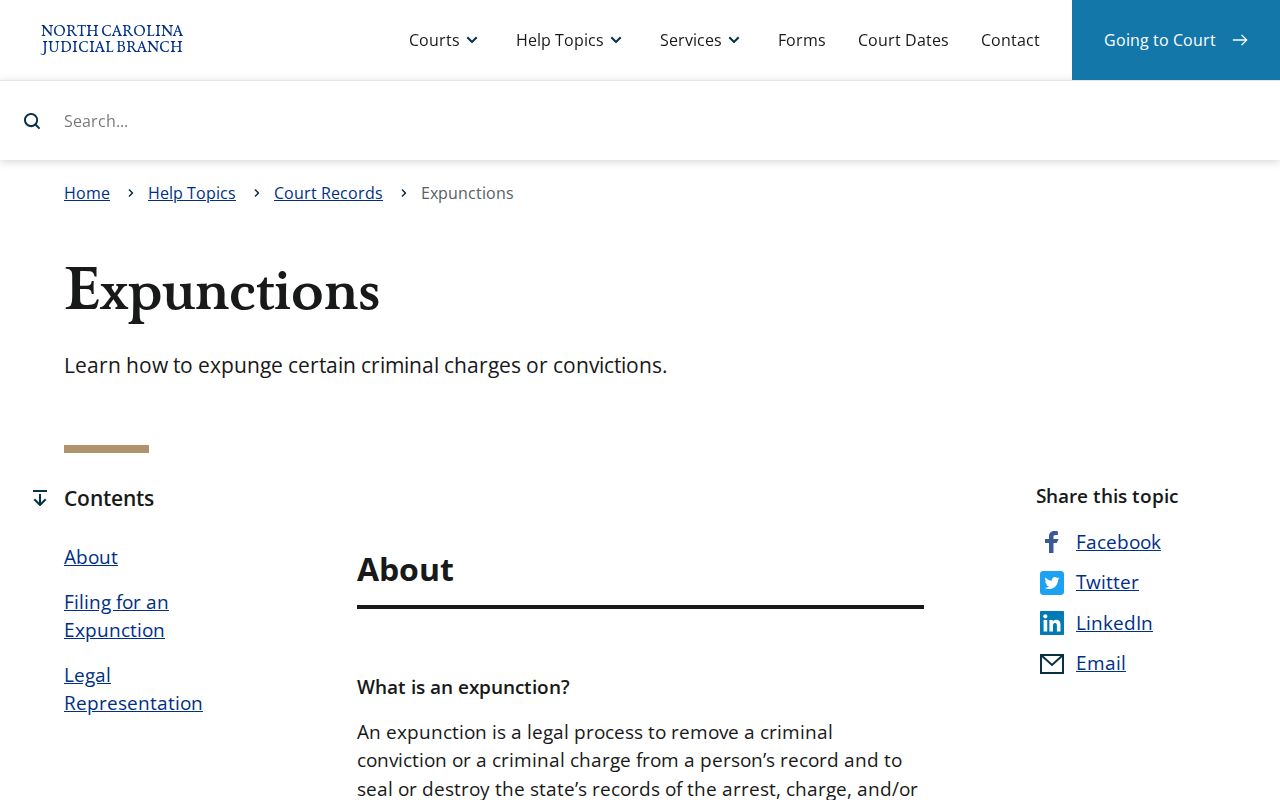
Eligibility depends on the current statute, the complete record, and sentence completion rather than the short offense label. Processing may take months because record checks, service, and a hearing can be required.
After an order is entered, the clerk distributes it to designated agencies. MCSO specifically requires receipt of a judge-signed Order of Expunction before it removes arrest or resident data ahead of its normal three-year display period. Recheck Portal, MCSO, and a later SBI Right to Review. If data persists, send the certified order to the office still displaying it and use the SBI challenge path for repository errors.
Mecklenburg Custody Records Have Three Layers
A Mecklenburg County jail search, a state correctional search, and a federal inmate search answer different questions. MCSO tracks local pretrial custody at Detention Center Central. VINE at 1-800-247-9658 can provide charges, bond, housing, court dates, and release notification for committed residents, but it does not include people who bonded out before commitment. For general detention information, MCSO lists 704-336-8100.
The NCDAC Public Offender Search covers state correctional and community-supervision records.
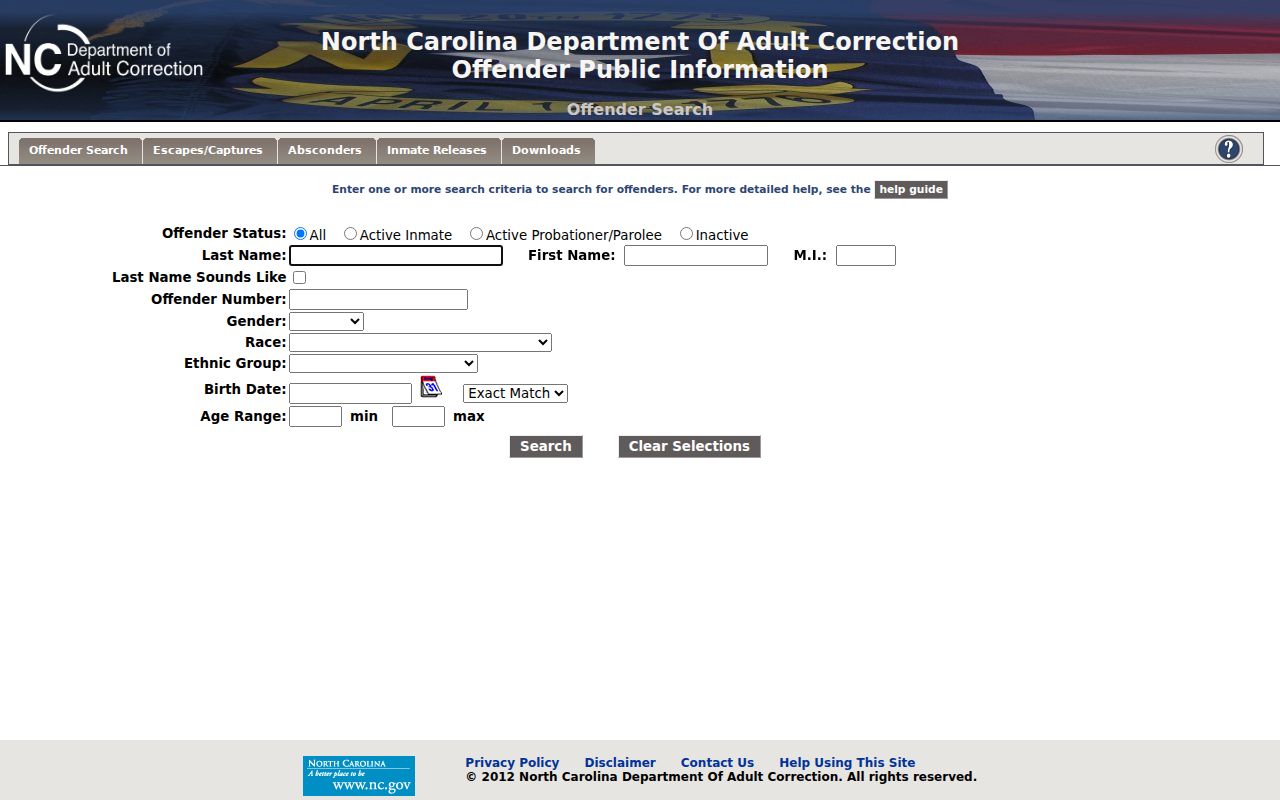
Its status does not replace an MCSO booking entry or disclose a full probation case plan. Compare it with the court judgment when Mecklenburg County probation, post-release supervision, or prison history matters.
Federal cases from Mecklenburg County lie in the Western District of North Carolina.
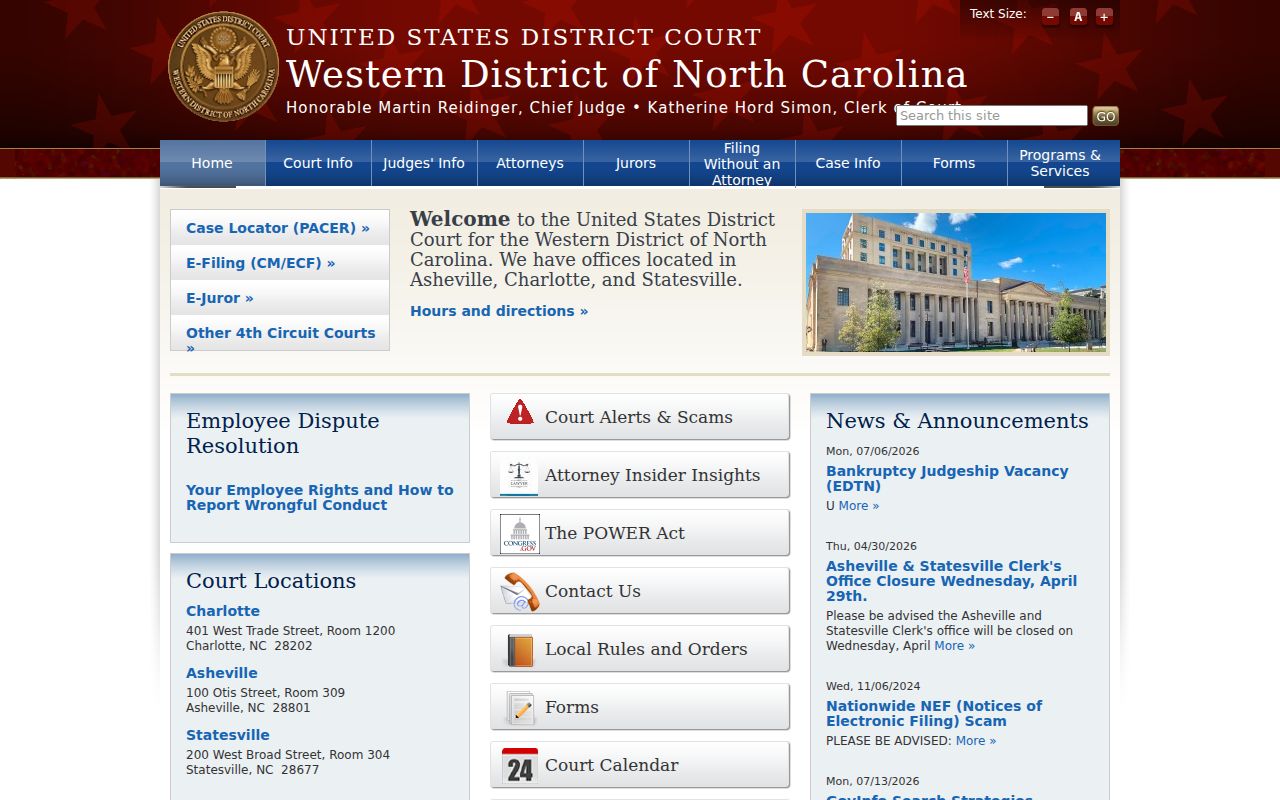
PACER holds public federal dockets, subject to registration and its current fee rules. A federal docket is not an FBI rap sheet or local jail record.
The Federal Bureau of Prisons locator is the separate custody layer.
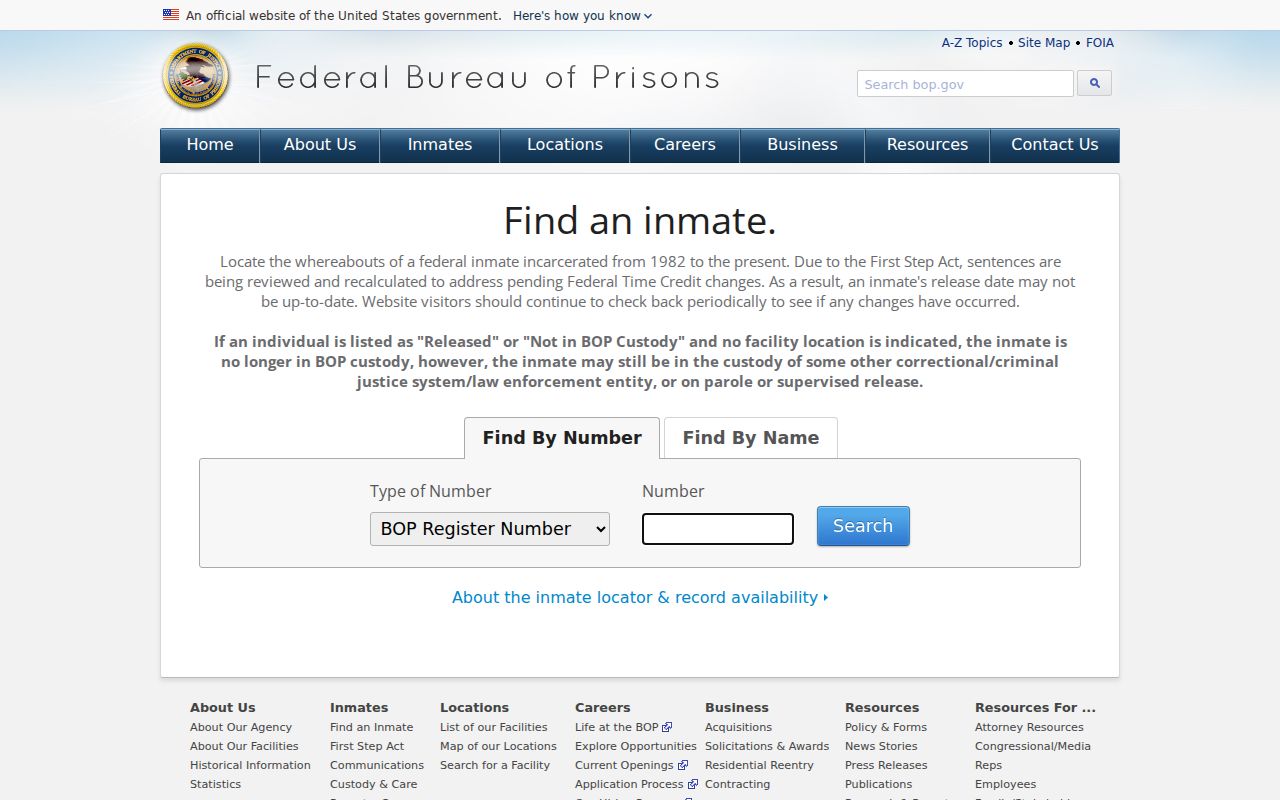
It does not list a person held only by MCSO or NCDAC, so an empty federal result says nothing about local or state custody.
City-by-City Criminal Records in Mecklenburg County
Charlotte, Huntersville, and Cornelius police departments create their own incident and crash reports, but custodial bookings converge at MCSO and criminal charges proceed in Mecklenburg County District or Superior Court. North Carolina does not operate separate municipal criminal courts for these cities. Each city record check therefore starts with its police records channel and then moves to county booking and state court systems.
Charlotte Record Check
2025 estimate 964,784 · CMPD reports, CrimeMapper, city requests, and MyCMPD alerts.
Huntersville Record Check
2025 estimate 68,535 · Huntersville Police reports route to MCSO booking and Mecklenburg court.
Cornelius Record Check
2025 estimate 35,094 · Cornelius Police requests and free eCrash search feed separate county case channels.
Mecklenburg Crime Counts Need Context
CMPD's official 2025 figures recorded 5,852 violent offenses, down from 7,436 in 2024. Homicides moved from 110 to 96, robberies from 1,389 to 1,050, property offenses from 37,451 to 35,112, and vehicle thefts from 7,442 to 5,960. These are reported offenses under UCR-style standards. They are not totals of arrests, filed Mecklenburg County cases, or convictions. One incident can produce no arrest, and one booking can contain several alleged charges.
The CMPD crime statistics page provides the source context and updated reports.
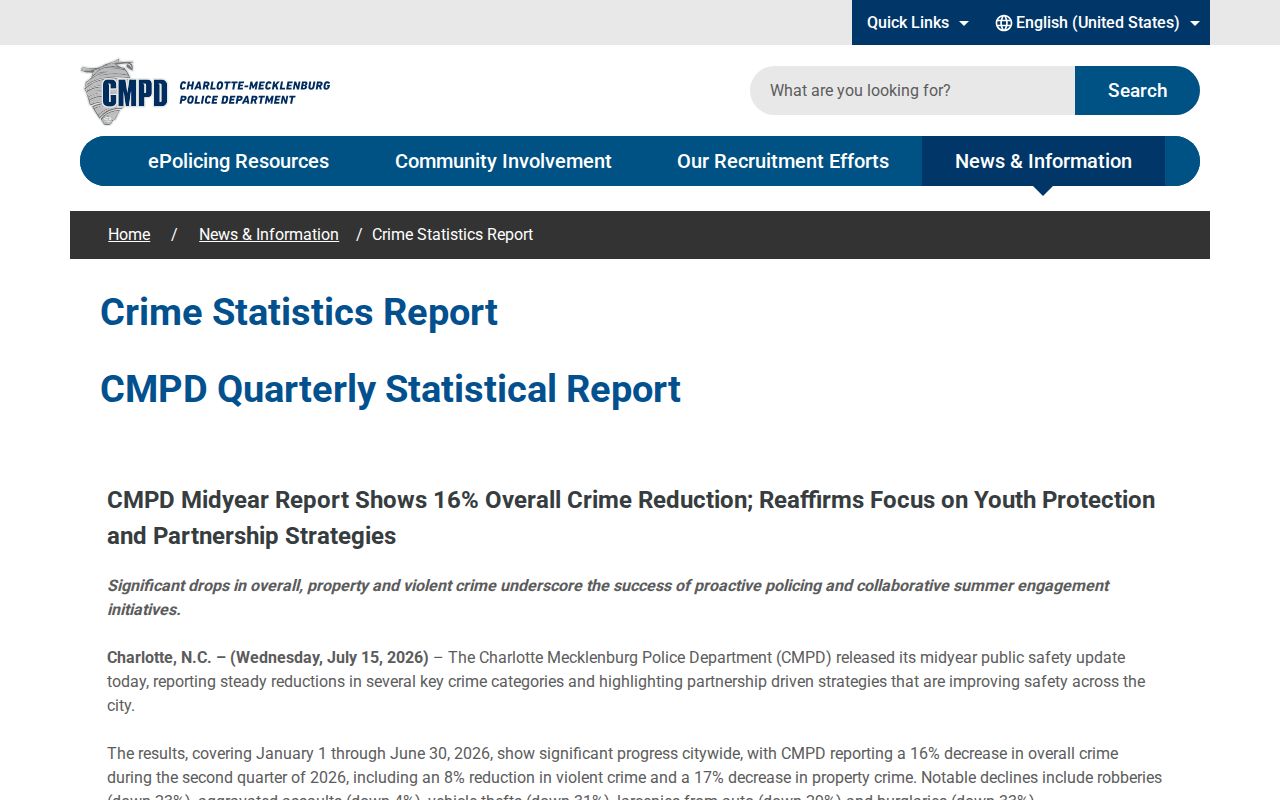
The image represents the incident-statistics channel, which should be read beside MCSO booking data and clerk dispositions rather than substituted for either.
Charlotte's scale also makes identity matching more important. Add date filters and compare case numbers, arresting agency, and outcomes. For an apparent mismatch, get a certified disposition from the clerk and follow the displaying agency's correction process. That measured approach is more reliable than drawing a conclusion from a single name or raw crime count.